
Three adult readers sit down to the same card game with three different expectations. One learned Teen Patti among friends, one has played only a few hands online, and one is trying either game for the first time. All three are over 18. None is wrong about the rules they have seen, because Teen Patti and Andar Bahar both change details from one version to another. The useful skill is asking which question a particular version puts to the player.
Starting from cards without assuming the rules
A game name travels through films, other players and a range of tables, picking up local variations along the way. That familiarity helps you follow the action, and it can also make you assume a step that this version skips. Treat the written instructions as the authority and your memory as a starting hint.
Teen Patti and Andar Bahar get compared because both use a standard deck and both are Indian in origin. Structurally they ask different things. Teen Patti asks you to assess a small hand and decide whether to keep paying to stay in. Andar Bahar asks you to pick a side and wait for a card that matches a reference card. One game turns on hand strength and betting choices; the other turns on where the first matching rank falls.
A short table, on paper or in a notes app, keeps a version straight. Use columns for version name, seats or positions, betting rounds, winning condition and side wagers. Replace any vague entry such as "standard" with an actual description. Two columns filled honestly beat ten columns of assumed rules.
Rules on a screen are easier to misread than on paper. Help panels collapse, menus move, and side-bet text can sit under a different tab from the main controls. Read the winning-condition text before staking anything, and check whether the version note sits at the top of the table or inside a settings drawer. If you cannot find the note, the table has not told you which version it runs.
Teen Patti: one name, several betting structures
Teen Patti deals a small hand, usually three cards, and builds a betting structure around limited information. In the simplest form each player receives three cards face down and may look at them or leave them hidden. Players bet across rounds, then fold or compare hands. The match’s character comes from the choice between paying a lower stake while blind and paying more once you have seen your cards.
That choice changes with the version. Blind and seen stakes follow a ratio that differs by table, and comparison may be against the next active player only or open to any active player once a stake threshold is met. Some versions compare every remaining hand at the end, and some add a side wager paid before the main hand. Cards and hand ranking can stay the same while each of these arrangements produces a different game.
Hand ranking is the part most players assume they know. Common order runs three of a kind, straight flush, straight, flush, pair, high card. Check that order against the table’s own text. Some versions merge or move a category, which can turn a familiar holding into a losing one.
It helps to describe Teen Patti on three separate layers. Card mechanics cover the number of cards, the ranking and any split-pot handling. Betting mechanics cover blind and seen stakes, raises and round limits. Table rules cover player numbers, the starting stake some versions collect, the maximum stake and side wagers. Two tables can share the first layer and differ entirely on the other two.
A dealer-comparison version adds another layer. In peer Teen Patti you win against other players’ hands. In a dealer-comparison version you play against the house’s hand under rules the table publishes. The same rank order may apply, but who you are beating changes the game.
Side wagers deserve separate attention. They usually pay on a condition such as a particular three-card combination, and they settle independently of the main hand. A loss on the main hand and a win on the side wager is a normal result. Keep the two outcomes apart in any record.
Take an invented hand with three adults at a table. Player A is blind and pays 10 units. Player B has seen and pays 20. Player C folds after the second round. Player A asks to compare with B, pays a shown stake of 20 units, and both hands are revealed. Higher rank wins the pot. Every part of that sentence is a rule that could differ elsewhere: the blind and seen amounts, the comparison cost, and whether comparison is limited to adjacent seats. Note which parts the table’s instructions actually confirm.
Pace follows from those rules. Short blind rounds compress a hand; longer rounds with several raises change how much information is available before a comparison. Extra time at a table offers a chance to read, not an advantage in itself. Side wagers run as their own track with their own winning condition.
Andar Bahar and its reference card
Andar Bahar turns on one card. A reference card is revealed, then cards are dealt into two sides, Andar and Bahar. The first card that matches the rank of the reference card makes that side win. Suit does not matter. A seven of spades as the reference is matched by any seven, whatever its suit.
Which side has the first chance to match depends on the version. Many tables send the first dealt card to Andar, some start with Bahar, and some burn a card before the sequence begins. Read the dealing order from the table’s instructions rather than assuming a fixed start. The order, not the side’s name, tells you where the first chance falls.
Some versions allow a bet on how many cards will appear before the match. That wager settles against a different event from the main side bet. Record it separately, because a main-side result and a length-of-deal result can disagree.
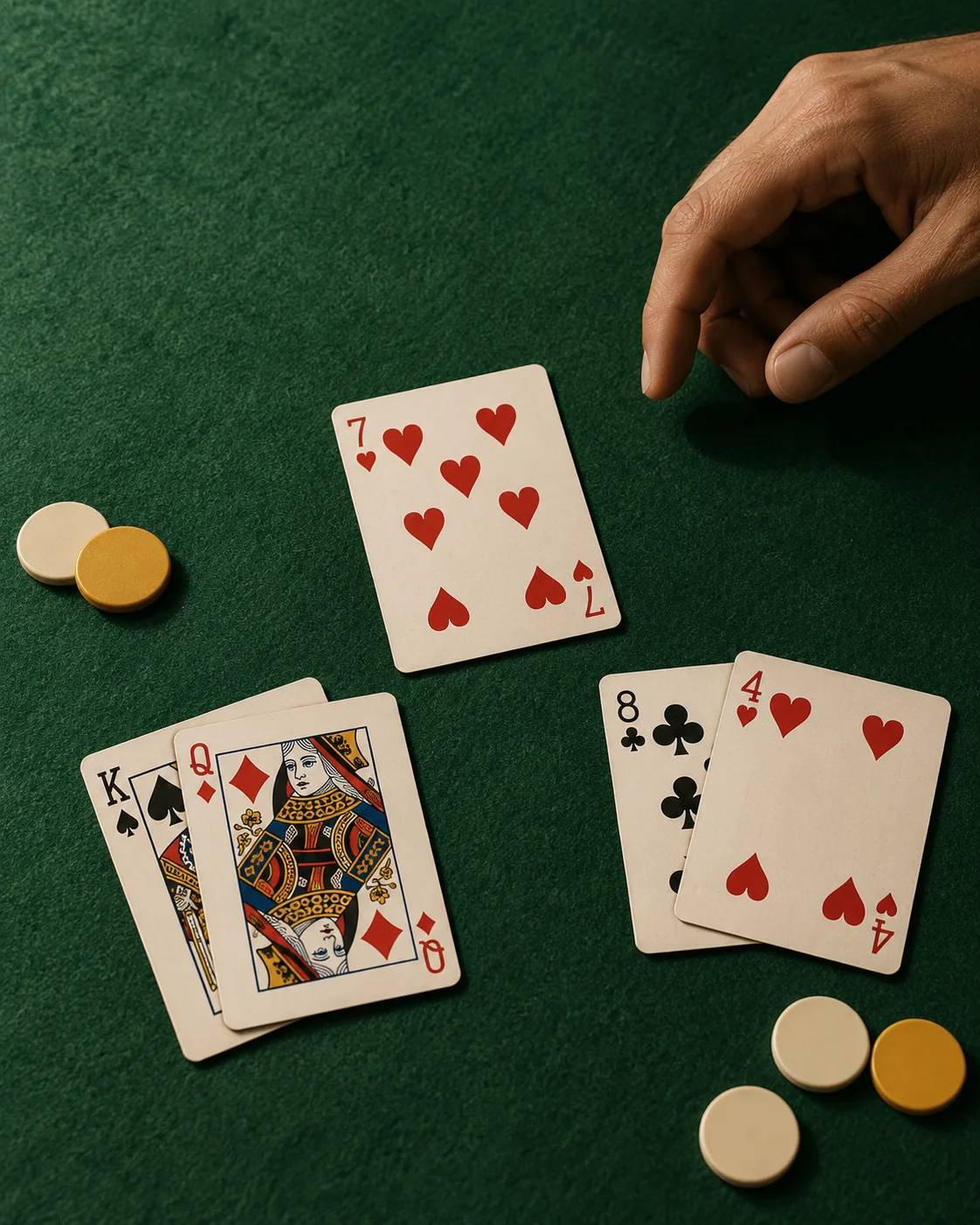
A dealt example makes the matching rule concrete. Suppose the reference card is the seven of hearts and the hypothetical sequence is four of clubs, king of spades, seven of diamonds. The first rank match is the seven of diamonds, the third card. If Andar receives cards one and three, then Andar wins; with the same sequence and Bahar on those positions, Bahar wins. The sequence stops at that match, so no later card is dealt once the side is decided. Nothing about suit changes the result, only the position of the first matching rank.
A recording or transcript serves better than memory. Note the reference card, the order of cards actually dealt, and which position the first rank match fell on. If the table offers a length-of-deal wager, note it separately. The main side and the length bet can settle differently in the same round.
Keeping a version ledger
The ledger idea covers both games. In a notebook or document, create one row per table and version. Columns: version name, number of players or positions, betting structure, winning condition, side wagers, and where the rules came from.
A filled hypothetical row might read: version "Three-Player Blind Show," three seats, blind 10 units and seen 20, comparison needs a show stake, side wager on a three-card combination, rules from the on-table help panel. The numbers are illustrative; each cell has a definite answer. A hypothetical Andar Bahar row might read: two positions, first deal to Andar, rank match decides, length-of-deal side wager, rules from the help text.
When a menu shows a named version, check that the name on the table matches the name in the help panel. Provider-branded versions can carry small variations within the same family, and the help panel is where those variations are documented. A table with no version note earns its own row saying so.
Identity matters when repeating a claim. A screenshot of a table with a version title proves that title appeared on that screen at that time. It does not prove the same version runs elsewhere. File the screenshot with a date and the timezone shown on the screen.
An attributed poker comparison, kept short
Readers who come from poker meet familiar words in a new setting. The site PlayWSOP presents Texas Hold’em and Omaha as virtual-chip formats for adults 21 and over, with no real-money gambling or prizes there. Those details belong to PlayWSOP. In Hold’em, the best five-card hand may use zero, one or two hole cards with five, four or three board cards. Standard four-card Omaha requires exactly two hole cards and three board cards. Whether Parimatch lists any poker format is not established here.
Where slots, live tables and cricket sit
Card games sit inside a wider floor that includes slot reels, live dealer tables and cricket. Each family answers a different question, and mixing them in one comparison tends to blur the result. Slots answer a question about a completed spin, live tables answer a question about a completed round, and cricket answers a question about a match outcome.
Slots carry the heaviest arithmetic. Every spin charges a total bet, and a paytable pays an award based on a stated base unit, which may be the line stake, the total bet or a credit value. Suppose a paytable expresses awards in line stake and a line stake of 5 units returns a 20x entry, then that line awards 100 units before other adjustments. Total charge, awards and net result are three different numbers. The slots guide on this site covers paytable reading and INR arithmetic in detail, including the difference between a theoretical long-run figure and a single result.
Live dealer tables have a human dealer, a physical table, and a round you can watch in time. Animated and recorded formats can look similar and settle on a different basis. Seeing a live stream is not proof that a bet was accepted or settled. Read the table record after the round.
Cricket settles against a result that comes from the match, not from a card sequence. A scoreboard and a casino round record do different jobs; one does not validate the other. The live casino guide here traces a typical round timeline, what a stalled stream looks like, and how a recorded settlement is checked.
Money, time and promotional language
Money language splits into separate meanings. A game credit is a unit inside the game; an INR amount is in rupees; a promotional term is a condition attached to an offer. A number on screen that reads 100 could be 100 credits, 100 rupees, or a 100x multiplier. Read the unit label next to the control you press.
Bonus is another split word. In a slot, a bonus round is a game state with its own rules. In a promotion, a bonus is an amount or free spins subject to conditions. A game bonus round does not remove the risk of the underlying stake, and a promotional amount does not change the game’s mechanics.
For INR arithmetic, keep units visible. A hypothetical even-money wager of ₹20 returns ₹40 gross on a win, a net profit of ₹20. Twenty in-game credits are not rupees unless a published conversion says so; check the label before comparing a credit figure with a rupee figure.
Timers need the same care. A promotional deadline should state its timezone, and the countdown may show hours and minutes. Read the timezone on the page, convert it explicitly to your own time, and write both the round time and the deadline, with date, in your notes.
Sort claims by what would prove them. A hand-ranking claim is proven by the rules text. A settlement claim is proven by the round record. A promotional claim is proven by the offer’s terms page. If the proof is missing, hold the claim as a question.
Documents sometimes disagree. A help panel may name one version while a menu label names another. When that happens, stop and clarify the current rules before acting; a stricter reading is not automatically the correct one.
Business roles also need scoping. A publication that describes a game, an operator that runs it and a provider that supplies it are three different roles. A domain name is not a licence, and a description of a game is not a statement of availability.
Checking a claim before repeating it
The overall position is straightforward. A clear understanding of how a hand or a sequence produces a result makes the rules and outcomes easier to follow. Other parts of the floor, from slots to promotions, add layers that need their own reading.
A four-step routine keeps claims in order. Write the version name as it appears on screen. Copy the winning condition from the rules into your notes. Record the settlement from the round. Compare all three with the most authoritative source you can reach. If any step is missing, repeat the exercise before drawing a conclusion.
Begin with a question rather than an assumption. Instead of "is this Teen Patti?" ask "which Teen Patti version does the help panel document, and does the table match it?" For Andar Bahar, ask "which position receives the first card, and can a burned card change the sequence?"
Six fields cover most comparisons: date and stated timezone, table or game name, version name, betting structure, winning condition, and a settlement note. Six fields fit on a phone and force you to name what you actually saw.
On a narrow screen the note still works but the reading context changes. Help panels move behind an icon, menus overlap the table, and version notes hide in settings. When the layout hides the note, open a wider view before staking anything.
Take a hypothetical table described as a three-player card game with blind and seen stakes. Your notes should include base stakes, comparison cost, version name and the settlement record. The claim you might repeat, "this is standard Teen Patti," is the one the notes should either confirm or challenge.
Stopping rules matter. If the rules cannot be found, or two documents disagree about who wins, stop and clarify before acting. A game is easier to follow when its outcome can be checked against readable instructions.
Common questions about the card games
The card-led route through the floor begins with reading, not staking. Get the version note, get the winning condition, then decide whether the game is the one you meant to play.
Is Teen Patti the same game everywhere?
Hand ranking tends to travel, but the betting structure does not. Blind and seen stakes, comparison rules and side wagers vary between versions. Read the table’s rules before assuming a remembered version applies.
Does suit matter in Andar Bahar?
In the versions described here, no. The first card matching the rank of the reference card wins for its side. A seven of any suit matches a seven of any suit. Check the ruleset for other details, such as a burned card or the order of the first deal.
Can I compare Teen Patti and Andar Bahar as the same kind of game?
They share a deck and a country of origin, but the questions differ. Teen Patti asks which small hand is stronger and whether a betting decision was worth it. Andar Bahar asks which side produces the first rank match. Compare them by structure, not by name.
How do slots, live tables and cricket fit into this article?
They sit around the card games as separate families. Slots settle per spin and are covered in the slots guide. Live tables settle per round and are covered in the live casino guide. Cricket settles against a match result. Keep families separate when recording an outcome.
Where does promotional language fit?
A promotional amount is a condition attached to an offer, not a change to a game’s mechanics. If an amount appears in a description, check its terms page. This publication is for adults aged 18 and over, and T&C apply.